
Yes. ESLs are worth it for convenience stores. They significantly reduce labor spent on manual price changes, improve shelf-to-register price accuracy, and provide scalable technology that allows small-format stores to start with one section and expand over time without a full-store rollout.
For years, electronic shelf labels (ESLs) were viewed as technology built for big-box retailers and large grocery chains, not small-format retail. But that perception is changing quickly. Today, ESLs for convenience stores are becoming a practical and increasingly necessary solution as operators face labor shortages, constant price changes, and rising expectations for accuracy and speed. When evaluating convenience store technology, ESLs are no longer a “nice to have”; they’re a tool that directly supports day-to-day operations.
The question many operators are asking is simple: are electronic shelf labels worth it for convenience stores? From a small-format perspective, the answer is yes, especially when labor efficiency, price accuracy, and scalability are considered together.
Convenience stores are designed to operate lean. Small teams, long operating hours, and high transaction volume leave little room for inefficiency. Labor already represents one of the highest operating costs in the industry, accounting for roughly 38% of gross profit, and 88% of convenience retailers identify recruiting as their top operational challenge. These pressures make automation increasingly important for store operations.
This is where ESLs reduce labor in convenience stores, becoming a critical part of the value conversation. Manual price changes require printing tags, walking the store, replacing labels, and double-checking accuracy. These are tasks that pull staff away from customers and revenue-driving activities. ESLs automate this process by syncing shelf prices directly with the POS or back-office system. Instead of dedicating labor hours to repetitive pricing tasks, teams can focus on foodservice, inventory, and customer experience.
For small-format stores, ESLs don’t replace employees; they help limited teams work more efficiently in an environment where every labor hour matters.
Price accuracy plays a major role in customer trust, particularly in convenience retail, where speed and simplicity are expected. Price mismatches between the shelf and the register can slow transactions, create frustration, and damage trust, especially during peak traffic periods.
As part of today’s convenience store technology, ESLs virtually eliminate this risk by ensuring shelf prices always match the POS. Industry studies show that ESL implementations can reduce pricing errors by as much as 99%, significantly improving consistency and minimizing costly mistakes. Accurate, automated pricing protects margins while supporting faster, smoother checkout experiences.
When evaluating ESLs for convenience stores, accuracy is not just an operational benefit, it’s a customer experience advantage.
One of the most common misconceptions about ESLs is that stores must convert their entire sales floor to see value. In reality, scalable ESL solutions for small stores are one of the technology’s strongest advantages.
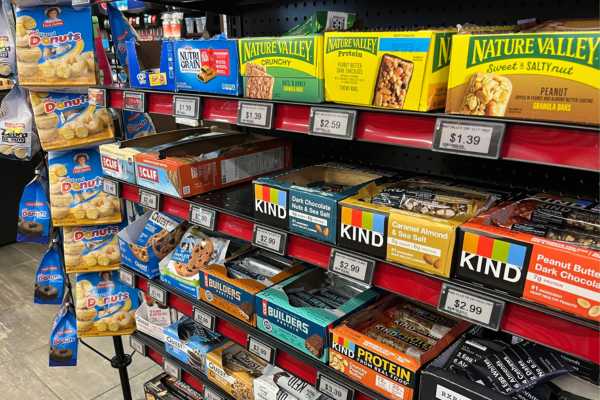
Many convenience store operators begin with a single category, such as beverages, tobacco, or cooler doors. These categories are where price changes are frequent and impact is immediate. From there, ESLs can be expanded gradually as budgets allow or operational needs evolve. This phased approach lowers risk, controls costs, and allows stores to measure ROI before scaling further.
For growing convenience store chains, ESLs also create a repeatable pricing framework that can be standardized across locations, supporting consistent operations as the business expands.
Convenience stores operate differently than traditional grocery, and modern ESL platforms are designed to support that reality. High SKU turnover, limited shelf space, and frequent pricing changes require flexible systems that won’t slow operations down.
As part of a broader convenience store technology strategy, ESLs support promotions, vendor-funded discounts, and rapid price adjustments without adding operational complexity. This flexibility helps stores remain competitive in a market where pricing pressure and customer expectations continue to rise.
With more than 152,000 convenience stores operating across the U.S., the industry depends on speed, accuracy, and efficiency to stay competitive. Small operational improvements can have an outsized impact when applied at scale.
When viewed through the lens of daily store operations, ESLs for convenience stores clearly address today’s most pressing challenges. They reduce the labor required to manage pricing, improve shelf-level accuracy, and provide a scalable foundation for future growth. Unlike many technologies that require major process changes, ESLs integrate naturally into existing workflows and POS systems.
For convenience store operators evaluating new technology, ESLs stand out because they deliver immediate operational benefits while supporting long-term scalability. The conclusion is straightforward: yes, electronic shelf labels are worth it for convenience stores.