

As 2025 comes to a close, Canada’s grocers find themselves at a delicate intersection. Retailers across the country have navigated one of the most demanding operating environments in recent memory, marked by sustained economic pressure, evolving consumer behaviors, and accelerating technological complexity. Yet through it all, the grocery industry has demonstrated resilience, adaptability, and a growing willingness to rethink long-standing operational models.
This past year reinforced a critical reality for Canada’s grocers: with net margins often below 3%, every operational, technological, and commercial decision now carries immediate and measurable consequences. Inaction, delayed response, or fragmented systems now carry real consequences; they are strategic risks.
In 2025, Canada’s grocers operated under the weight of persistent supplier cost inflation, estimated at approximately 4.2%, while food price growth continued to exceed the broader Consumer Price Index. These pressures reshaped consumer behavior, intensifying price sensitivity and weakening traditional brand loyalty.
At the same time, grocers faced mounting structural challenges: supply chain instability, shrinking basket sizes, tariff-related impacts, stricter data privacy requirements, enhanced nutritional labeling mandates, and changes to in-store product presentation. Cybersecurity and business continuity also moved to the forefront, as retail security incidents continued to rise year over year.
Rather than stemming from a single disruption, pressure in 2025 came from the accumulation of forces—economic, regulatory, and operational—that compressed margins and shortened decision-making windows for grocers of all sizes.
Despite these headwinds, Canada’s grocers, both independent and enterprise, demonstrated notable resilience. Access to better-integrated technologies, tighter operational controls, and strong strategic partnerships allowed many retailers to maintain stability and protect growth.
However, resilience in 2025 proved to be less about reacting to crises and more about building durable organizational capabilities. As operating costs rose faster than revenues, resilience evolved into a discipline, one that must be continuously structured, measured, and refined.
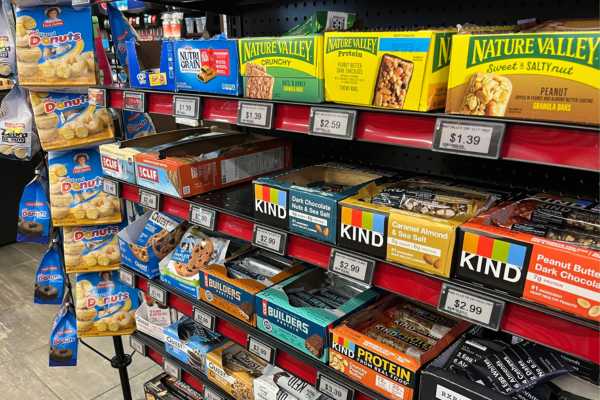
One of the most impactful developments of the year was the broader adoption of electronic shelf labels (ESLs). In an environment defined by frequent price changes, ESLs became essential tools for preserving margins, ensuring price accuracy, and reducing manual workload.
Beyond efficiency gains, electronic shelf labels enhanced the in-store experience through clearer, more consistent pricing aligned with promotions. Grocers reported fewer pricing errors, lower labor costs associated with price changes, and greater commercial agility. Some retailers even leveraged electronic shelf labels strategically to influence shopping behavior and support average basket growth.
In 2025, pricing technology was no longer a convenience; it became a safeguard against volatility.
Consumer behavior continued to shift throughout the year. Loyalty to a single banner weakened as shoppers increasingly sought value across multiple retailers. Many consumers now visit three or more grocery banners regularly, favoring operators capable of synchronizing pricing, promotions, and communications across channels.
This evolution forced Canada’s grocers to reassess the value they deliver beyond shelf price alone, placing greater emphasis on clarity, relevance, and consistency.
Traditional points-based loyalty programs showed clear signs of fatigue in 2025. In response, grocers increasingly turned to customer segmentation and targeted offers built on real purchasing behavior.
When executed effectively, these loyalty strategies humanized the customer relationship and delivered tangible benefits aligned with individual needs. Grocers investing in personalization saw significantly higher redemption rates compared to generic programs. Notably, the most recognized and awarded loyalty initiatives in recent years have shared one common trait: intelligent, structured use of data.
Used poorly, data adds complexity. Used well, it becomes a lasting competitive advantage for Canada’s grocers.
Another defining shift in 2025 was the reassessment of self-checkout strategies. While self-checkout remains embedded in shopping habits, many grocers observed declining transaction volumes at these lanes alongside rising concerns around loss and shrink.
Self-checkout is no longer viewed solely through the lens of labor efficiency or customer convenience. Loss management, transactional security, and margin protection are now central to the conversation. In some environments, unmanaged self-checkout loss rates have proven to be two to three times higher than those of traditional checkout lanes.
Rather than abandoning self-checkout, grocers focused on refinement. Technologies such as image-based product recognition, behavioral analysis, and smart camera systems helped reduce shrink while preserving customer autonomy.
The challenge of 2025 was clear: how to offer freedom without creating vulnerability, and automation without losing control.
For Canada’s grocers, supply chain performance emerged as one of the most critical differentiators of 2025. Lead time variability, logistics costs, and unpredictable demand turned inventory management into a high-stakes balancing act.
Stockouts became more than operational issues; they represented broken promises to customers. At the same time, overstocking tied up capital, increased waste, and eroded margins.
Grocers who succeeded connected supply chain data directly to store operations and marketing decisions. Real-time visibility, synchronized pricing and promotions, and rapid frontline responsiveness transformed complexity into control.
As the industry moves into 2026, the pace of change shows no sign of slowing. Margin pressure will persist. Consumer expectations will continue to rise. Technology will grow more powerful and more complex.
“The retailers who will thrive in 2026 are those who turn complexity into clarity,” says Francis Desroches, President, Canada at Ravyx. “Success will come from making smarter, faster decisions while staying grounded in operational reality.”
According to Rainer Wellige, Vice President of Sales, Canada, the focus must remain practical. “Technology alone doesn’t create value. Value is created when systems work together, teams are empowered, and grocers can move at the pace of their market; not faster, not slower.”
The future of Canada’s grocers lies in coordinated execution: aligning channels, understanding behavior, and translating data into actionable decisions. Modernization is no longer a destination; it’s a continuous process shaped by each retailer’s unique market, scale, and strategy.
As 2026 begins, one certainty remains: long-term success will depend on strong partnerships, clear vision, and the ability to act decisively without losing sight of what matters most.